Fragility Fracture: What It Means and Why You Should Ask for a Fracture Liaison Service
A fragility fracture is a break from a fall from standing height or less. Why it predicts the next one, what a fracture liaison service does and how to ask.
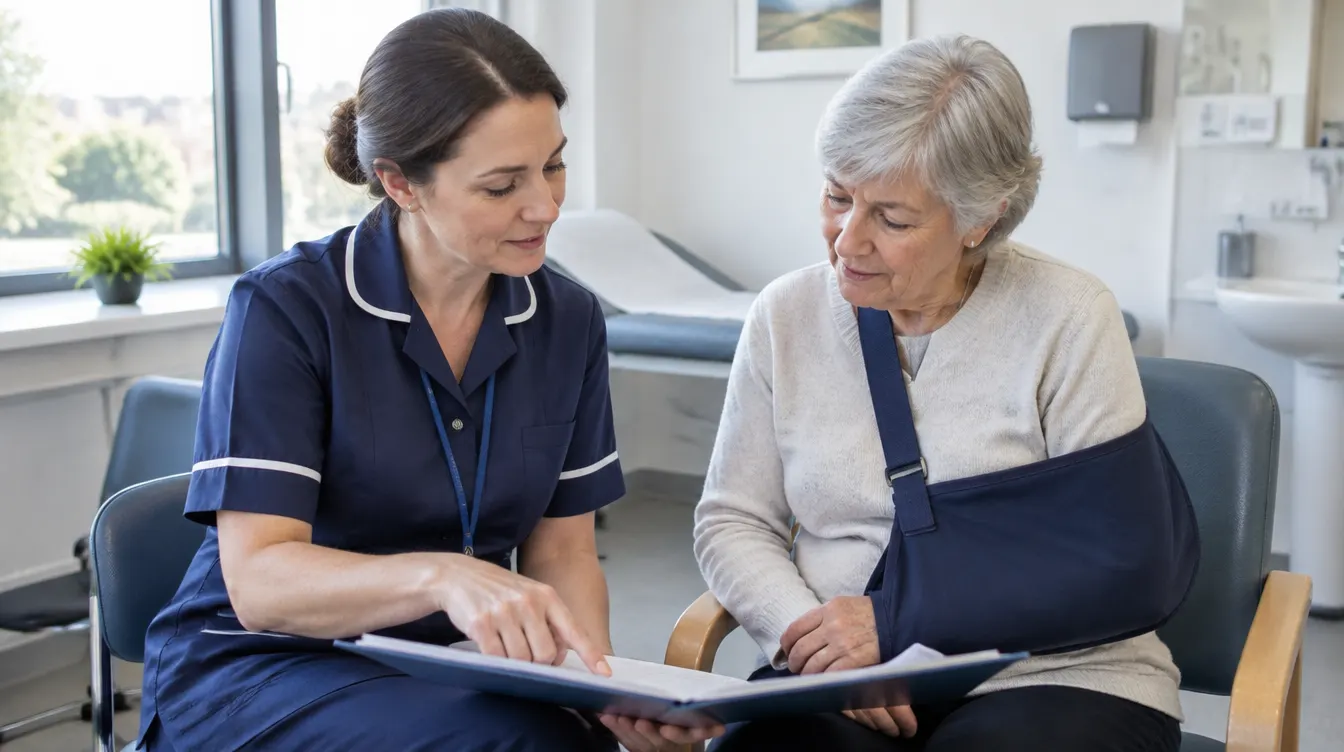
A fragility fracture is a broken bone from a fall from standing height or less, or a force that would not normally break a healthy bone. It matters because one fragility fracture roughly doubles the chance of another, and that risk is highest soon afterwards. A fracture liaison service is the NHS team that finds people after a first break and works to stop the next one, and if you are over 50 you can ask your GP about it.
What is a fragility fracture?
A fragility fracture is a low trauma fracture sustained from a fall from standing height or less. That is the definition used in the 2024 UK clinical guideline for osteoporosis, written by the National Osteoporosis Guideline Group (NOGG) Archives of Osteoporosis, 2025. Put simply, it is a bone that broke from a stumble, trip or bump that would not usually break a healthy bone.
Examples include breaking your wrist after slipping on a kerb, or your hip after a fall at home. The NHS lists a broken wrist, a broken hip and broken spinal bones (vertebrae) as the most common injuries in osteoporosis, and adds that breaks can also happen in other bones such as the arm or pelvis. It notes that sometimes even a cough or sneeze can cause a broken rib NHS.
Spinal fractures are easy to miss because they do not always follow a fall and can be put down to ordinary back pain. Our guide to spinal fractures and osteoporosis explains the signs, including losing height.
Does a fragility fracture mean you have osteoporosis?
Not automatically, but it is one of the clearest warning signs. The NHS says osteoporosis is often only diagnosed when a fall or sudden impact causes a bone to break NHS. That is why osteoporosis is often called a silent condition. Many people have no idea their bones are thin until one breaks. Our guide to what osteoporosis is explains the condition, and signs of osteoporosis covers the warning signs.
UK guidance recommends that patients with osteoporosis and/or a fragility fracture should be investigated for underlying causes NOGG, 2024. NOGG also describes a case-finding strategy, where people are identified because of a fragility fracture, as appropriate in the absence of a screening programme.
Why does the first fracture predict the next?
Because a fragility fracture shows your bones are already more fragile, and the risk of another break is highest soon afterwards. NOGG says fracture risk is approximately doubled in the presence of a prior fracture, and the effect is even more marked for more than one vertebral fracture NOGG, 2024.
Timing matters too. The guideline says that after a fracture, the risk of subsequent fracture is highest in the immediate post-fracture interval, which it calls imminent risk Archives of Osteoporosis, 2025. So NOGG recommends starting treatment promptly following a fragility fracture, because risk of re-fracture is highest immediately after a fracture and remains raised NOGG, 2024. It also lists a recent spinal fracture, within the last two years, as a sign of very high risk that may warrant referral to a specialist.
What is a fracture liaison service?
A fracture liaison service (FLS) is an NHS service that systematically identifies people aged 50 and older who have had a fragility fracture, with the aim of reducing their risk of further fractures Royal Osteoporosis Society. The Royal Osteoporosis Society calls FLS the gold standard for fracture care Royal Osteoporosis Society, 2022.
UK guidance supports them directly. NOGG recommends that patients who sustain a fragility fracture should have access to a multidisciplinary, coordinator-based Fracture Liaison Service, which enables timely fracture and falls risk assessment, investigation, treatment and monitoring NOGG, 2024.
The ROS describes the service as proactively finding people after a first fracture, starting them on bone medication and monitoring them for 12 months. It says FLS reduce re-fracture rates by up to 40% Royal Osteoporosis Society.
What happens at a fracture liaison service assessment?
You are assessed and supported by a nurse, or a doctor with expertise in osteoporosis Royal Osteoporosis Society, 2022. Services differ, but an assessment usually includes:
- Your fracture risk, worked out with a tool such as FRAX. Our explainer on fracture risk and FRAX shows how it works.
- A bone density (DEXA) scan where it is needed.
- Checks for underlying causes, such as blood tests.
- A falls assessment. NOGG recommends assessing falls risk in people with fragility fractures and offering those at risk an exercise programme to improve balance and muscle strength NOGG, 2024.
- Treatment and follow-up if your risk is high, often a bone-strengthening medicine. See our osteoporosis treatment guide.
If you are prescribed a bone medicine, take it exactly as instructed and do not stop or change it without speaking to your doctor first.
How do you ask for a fracture liaison service assessment?
If you are over 50 and have broken a bone, ask your GP surgery whether a fracture liaison service is available near you. That is the NHS's advice, which notes that an FLS can help you prevent further broken bones NHS. At some hospitals you may be referred to an FLS automatically after breaking a bone Royal Osteoporosis Society.
Useful things to say to your GP:
- "I broke my wrist (or hip, or another bone) in a fall from standing height. Could this be a fragility fracture?"
- "Is there a fracture liaison service I can be referred to?"
- "If not, can my fracture risk be assessed here, for example with FRAX and a bone density scan?"
If you have had a hip fracture, our guide to hip fracture recovery covers the bone health steps that should follow.
Are there gaps in fracture liaison service coverage in the UK?
Yes. Access depends on where you live, which the Royal Osteoporosis Society calls a postcode lottery. The ROS says Scotland has 100% FLS coverage Royal Osteoporosis Society. In 2022 it reported that only about half (51%) of NHS trusts in England and Wales had an FLS, compared with 100% coverage in Scotland and Northern Ireland Royal Osteoporosis Society, 2022.
In its 2026 campaign update, the ROS says 60 NHS trusts still lack an FLS and that only three of an estimated 59 new services needed had opened in two years. It reports that ministers have committed to rolling out fracture liaison services across England by 2030, and that national rollouts in Wales have recently been completed Royal Osteoporosis Society.
If there is no FLS in your area, you can still ask your GP for a fracture risk assessment. The Royal Osteoporosis Society also runs a specialist nurse helpline.
What else can you do after a fragility fracture?
Lower your chance of falling, look after your bones, and keep track of your bone health. Practical steps include:
- Strength and balance exercise. See our falls prevention exercises.
- Calcium, vitamin D and protein from your diet, and supplements if your doctor advises them.
- Not smoking and keeping alcohol within limits.
- Taking any bone medicine as prescribed.
Some people also want to keep an eye on their bones between NHS checks. Screen My Bones offers radiation-free REMS screening of the spine and hip. It is a screening and monitoring option, not a diagnostic test, and UK guidance (NOGG) does not recommend REMS for diagnosing osteoporosis, so DEXA remains the test for a formal diagnosis. It is not a substitute for a fracture liaison service or GP assessment after a fracture. Please discuss any result with your GP. You can read about our bone health assessment or book a screening.
This article is part of our bone health series. It is general information, not medical advice. If you have broken a bone, speak to your GP about your bone health.
References
- The 2024 UK clinical guideline for the prevention and treatment of osteoporosis — Archives of Osteoporosis (NOGG) (2025)
- Section 3: Fracture risk assessment and case finding — National Osteoporosis Guideline Group (NOGG) (2024)
- Summary of main recommendations — National Osteoporosis Guideline Group (NOGG) (2024)
- Osteoporosis — NHS
- Living with osteoporosis — NHS
- Fracture Liaison Services — Royal Osteoporosis Society
- What is a Fracture Liaison Service? — Royal Osteoporosis Society (2022)
- Two years on, still no plan — Royal Osteoporosis Society
- Broken hips, wrists and other bones — Royal Osteoporosis Society
Frequently asked questions
The 2024 UK osteoporosis guideline defines a fragility fracture as a low trauma fracture sustained from a fall from standing height or less. In other words, a bone that broke from a force that would not normally break a healthy bone. The wrist, hip and spine are common sites.
Related reading
Bone Health How Long Does a Fracture Take to Heal? Healing Times, Stages and What Helps
Screen My Bones Editorial Team30 October 20266 min readBone Health What Is Osteoporosis? Causes, Symptoms, Diagnosis and Treatment (UK Guide)
Screen My Bones Editorial Team30 October 20268 min readBone Health Falls-Prevention Exercises That Work: A UK Evidence Guide
Screen My Bones Editorial Team24 August 20265 min read
Check your bone health
Radiation-free REMS screening. No referral needed.