Calcium-Rich Foods: A UK Chart of Foods High in Calcium for Your Bones
Calcium-rich foods chart for UK adults: milk, cheese, yoghurt, sardines, tofu, kale and more, with portions and mg. How to reach 700mg a day, dairy-free too.
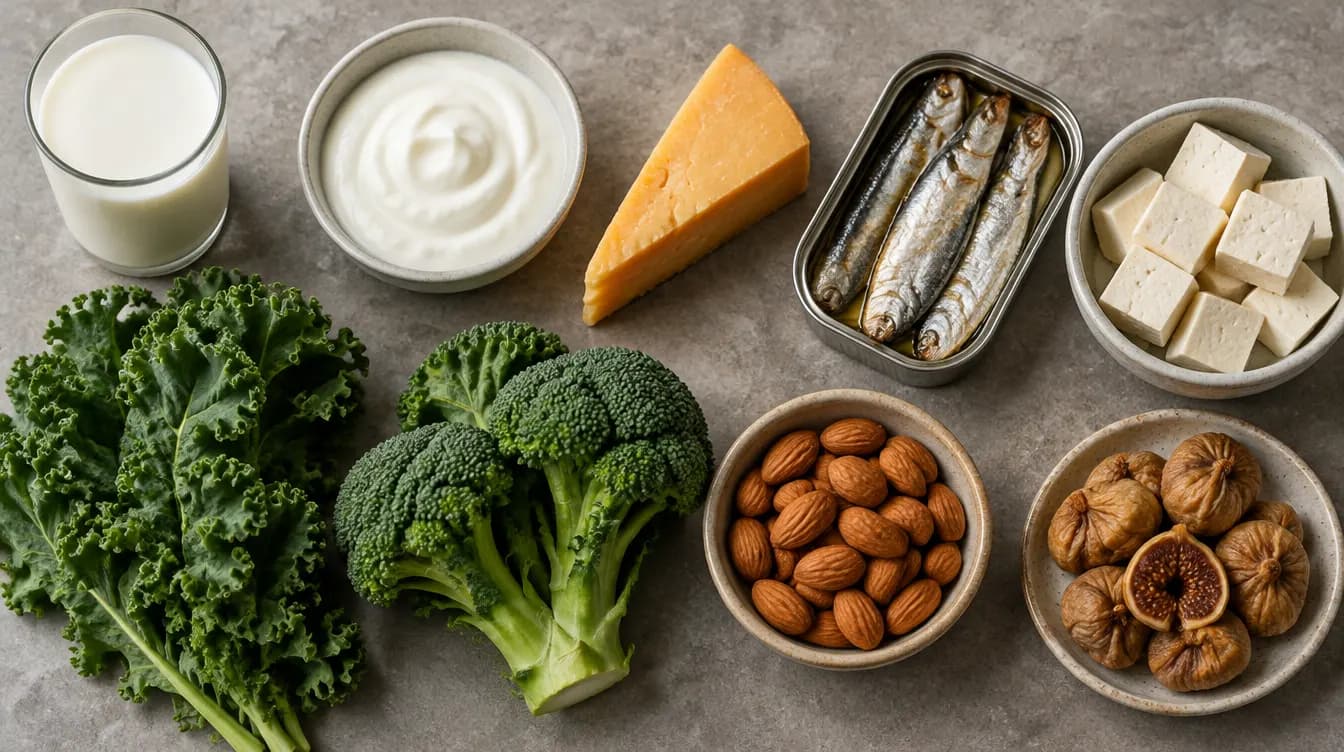
The foods highest in calcium in a UK diet are milk, cheese and yoghurt, tinned sardines and salmon eaten with the bones, calcium-set tofu, sesame seeds, fortified plant drinks, and greens such as kale, pak choi and okra. Most adults need 700mg of calcium a day, which three or four calcium-rich portions spread through the day can usually cover. The chart below gives typical portions and milligrams from the Royal Osteoporosis Society, so you can add up your own day.
How much calcium do you need a day in the UK?
Most adults in the UK need 700mg of calcium a day, including during pregnancy. This is the figure given by both the NHS and the Royal Osteoporosis Society (ROS) NHS Royal Osteoporosis Society. The national osteoporosis guideline (NOGG) treats 700mg as the minimum for adults and says food is the preferred source NOGG, 2024.
Some groups need more:
- Breastfeeding mothers: 1,250mg a day, according to the British Dietetic Association (BDA) BDA.
- Teenagers (11–18): 800mg for girls and 1,000mg for boys, while their bones are still growing BDA.
- People at risk of osteoporosis or on osteoporosis medicine: the ROS says your doctor may advise increasing your intake to around 1,000mg a day Royal Osteoporosis Society.
More is not automatically better. If you are wondering about the upper end, our guide calcium: how much is too much? explains the NHS supplement limit and the risks of taking too much.
Which foods are high in calcium? (UK chart)
Dairy foods, tinned fish with soft bones, calcium-set tofu, sesame seeds, fortified plant drinks and some green vegetables give the most calcium per portion. The chart below comes from the Royal Osteoporosis Society's calcium-rich food chooser Royal Osteoporosis Society, 2025. Figures are rounded to make adding up easy, so treat them as a guide. Labels on branded products may differ.
| Food | Typical portion | Calcium (approx.) |
|---|---|---|
| Milk (skimmed, semi-skimmed or whole) | 1 glass (200ml) | 200mg |
| Fortified plant drink (soya, almond, oat, coconut, hazelnut) | 1 glass (200ml) | 200mg |
| Cheddar cheese | Small matchbox-size piece (35g) | 200mg |
| Paneer | Small matchbox-size piece (35g) | 200mg |
| Yoghurt | 3 tablespoons (125g) | 200mg |
| Fortified soya yoghurt | 3 tablespoons (125g) | 200mg |
| Porridge made with milk | 1 bowl (160g) | 200mg |
| Sardines, tinned | Half a tin (60g) | 200mg |
| Tofu (calcium-set) | Palm-size piece (100g) | 200mg |
| Sesame seeds | 1 tablespoon (25g) | 200mg |
| Kale, boiled | 4 heaped tablespoons (80g) | 200mg |
| Salmon, tinned | 1 small tin (100g) | 100mg |
| Tahini | 1 heaped teaspoon (15g) | 100mg |
| Parmesan | 1 tablespoon (10g) | 100mg |
| Cottage cheese | 2 tablespoons (75g) | 100mg |
| Chickpeas | 4 tablespoons (150g) | 100mg |
| Almonds | 1 handful (30g) | 100mg |
| Pak choi | 1 pak choi (125g) | 100mg |
| Okra, boiled | 9 okra (80g) | 100mg |
| Watercress | 1 bag (60g) | 100mg |
| Dried figs | 2 figs (30g) | 100mg |
| White or wholemeal bread | 2 medium slices (90g) | 100mg |
| Baked beans | 4 tablespoons (150g) | 50mg |
| Green cabbage, boiled | 3 tablespoons (80g) | 50mg |
| Broccoli, boiled | 3 tablespoons (80g) | 25mg |
| Orange, or 2 satsumas | 80g | 25mg |
Source: Royal Osteoporosis Society calcium-rich food chooser (reviewed July 2025).
Two things stand out. Bread contributes more than most people expect. The NHS lists bread and anything made with fortified flour as a calcium source NHS. And broccoli, often called a calcium food, gives only about 25mg per portion. It is good for you, but it won't do much for your calcium total on its own.
What does 700mg of calcium look like in a day?
About three or four calcium-rich portions spread across the day will get most adults to 700mg. Using the figures in the chart above, here are two example days:
- With dairy: porridge made with milk (200mg) + a cheddar sandwich on two slices of bread (200mg + 100mg) + a yoghurt (200mg) = about 700mg.
- Dairy-free: a glass of fortified oat drink (200mg) + a hummus and tahini wrap with chickpeas (100mg + 100mg) + a tofu and pak choi stir-fry (200mg + 100mg) + two dried figs (100mg) = about 800mg.
If your doctor has advised around 1,000mg because of osteoporosis, add one or two more 200mg portions, such as an extra glass of milk or half a tin of sardines. Spreading calcium across meals is also easier than trying to fit it all into one.
What are the best dairy-free sources of calcium?
The best dairy-free sources are calcium-fortified plant drinks and yoghurts, calcium-set tofu, sesame seeds and tahini, and greens such as kale, pak choi, okra and watercress. Tinned sardines and salmon are good too if you eat fish, as long as you eat the soft bones.
The main thing to watch is fortification. The BDA notes that without added calcium, dairy alternatives "do not have a noticeable amount of calcium in them", and that "many organic products, for example, are not fortified" BDA. Check plant drinks and yoghurts for added calcium on the label, and choose tofu that says "calcium-set".
If you follow a fully plant-based diet, calcium is only one part of the picture. Our guide to bone health for vegans and vegetarians covers protein, vitamin D and B12 as well.
Why isn't spinach on the list?
Spinach contains calcium, but your body can't absorb much of it, so it is a poor source despite its reputation. The NHS notes that the body can't absorb all of the calcium in spinach NHS, and the ROS leaves spinach off its list of calcium-rich greens for the same reason Royal Osteoporosis Society.
The BDA explains that spinach, along with some dried fruits, beans, seeds and nuts, contains oxalates and/or phytates, which "reduce how much calcium your body can absorb" BDA. You don't need to avoid these foods, because they bring plenty of other nutrients. Just don't rely on them as your main calcium sources. Kale, pak choi, okra and watercress are better green options.
Do you need vitamin D as well as calcium?
Yes. Without enough vitamin D your body can't absorb and use calcium properly, however much you eat. The BDA says vitamin D "helps your body to absorb and use calcium from the foods you eat" BDA. In the UK the skin can't make enough vitamin D from winter sunlight, so the NHS advises everyone to consider a daily 10 microgram supplement in autumn and winter NHS.
Calcium works with other nutrients too, including protein, magnesium and possibly vitamin K2. See vitamin D for bone health for how much vitamin D to take, and our osteoporosis diet guide for how it all fits on a plate.
Should you take a calcium supplement instead?
For most people, food comes first, and a supplement is only for those who can't reach their target through diet. NOGG says dietary calcium is "the preferred option" and that calcium supplements should be targeted at people who don't get enough from food. Examples include housebound older adults, people in care homes, and people with malabsorption or after bariatric surgery NOGG, 2024.
Our guide do you need calcium supplements? explains who benefits and what the evidence says about the heart.
How do you know if your diet is protecting your bones?
You can't feel your bone density, so a diet that looks good on paper doesn't tell you how strong your bones actually are. Calcium is one building block, alongside vitamin D, protein, exercise and not smoking. If you have risk factors such as early menopause, long-term steroid use or a family history of hip fracture, talk to your GP about a fracture risk assessment.
If you would like a baseline, Screen My Bones offers a radiation-free bone health assessment using REMS ultrasound at the spine and hip, which can be repeated to track change over time. It is a screening and monitoring tool, not a replacement for a DEXA scan when a formal osteoporosis diagnosis is needed.
This article is part of our nutrition and supplements series.
References
- Calcium-rich food chooser — Royal Osteoporosis Society (2025)
- Calcium — Royal Osteoporosis Society
- Calcium (vitamins and minerals) — NHS
- Calcium: food fact sheet — British Dietetic Association (BDA)
- Section 5: Non-pharmacological management of osteoporosis — National Osteoporosis Guideline Group (NOGG) (2024)
- Vitamin D (vitamins and minerals) — NHS
Frequently asked questions
Per typical portion, the richest everyday sources in the Royal Osteoporosis Society's food chooser each give about 200mg: a 200ml glass of milk or fortified plant drink, a 35g piece of cheddar, 125g of yoghurt, half a tin of sardines (60g), 100g of calcium-set tofu, a tablespoon of sesame seeds, 80g of boiled kale and a bowl of porridge made with milk.
Related reading
Nutrition & Supplements Bone Broth and Bone Health: Does It Help?
Screen My Bones Editorial Team24 August 20265 min readNutrition & Supplements Vitamin D, Calcium and Protein for Bone Health
Screen My Bones Editorial Team26 June 20267 min readNutrition & Supplements Calcium: How Much Is Too Much? The UK Upper Limit Explained
Screen My Bones Editorial Team24 August 20265 min read
Check your bone health
Radiation-free REMS screening. No referral needed.